Hailemariam Desalegn Advocates For Multifaceted Reforms To Achieve No Stop Borders Across Africa
Beyond Physical Infrastructure Former Ethiopian Prime Minister Calls for Stronger Political Will to Unify Africa Borders
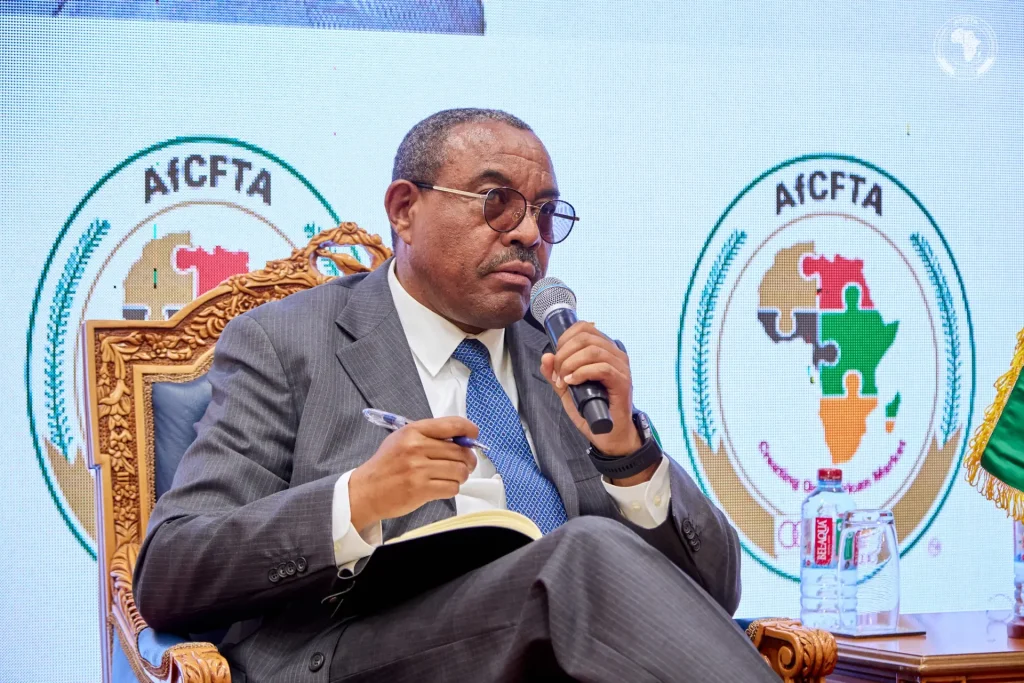
NAIROBI – Achieving the ambition of “no-stop borders” across the African continent will require far more than basic physical infrastructure upgrades, according to former Ethiopian Prime Minister and current TradeMark Africa Board Chair, Hailemariam Desalegn. In a high-level policy brief, the continental trade body underscored that genuine economic integration hinges on deep institutional coordination, unyielding political will, and predictable.
The strategy aims to directly support the execution of the African Continental Free Trade Area (AfCFTA) by lowering the structural costs and delays that heavily penalize cross-border trade.
In his address detailing the operational trajectory of the continent’s logistics networks, Hailemariam noted that the transition to frictionless transit lines involves overlapping technical, political, and systemic challenges.
“Building No-Stop Borders is multifaceted: technical, political and institutional,” Hailemariam stated. “Practical implementation starts with movers and momentum, region by region, corridor by corridor, beginning where alignment is strongest and where scaling works.”
The “No-Stop Border” model focuses heavily on removing non-tariff barriers (NTBs), such as redundant regulatory inspections, incompatible customs systems, and physical paperwork which experts estimate inflate intra-African trade costs by up to 30 percent.
Rather than just building physical customs stations, the initiative pushes for smart digital infrastructure, automated clearance procedures, and mutual recognition of quality standards between neighboring states.
The goal is to produce concrete, localized reforms that result in faster transit times and a highly stable trade environment that allows regional businesses to expand cleanly beyond their home markets.
Over the past 15 years, TradeMark Africa has actively collaborated with national governments, private sector organizations, and regional economic communities to streamline continental transport systems.
Through strategic interventions, the aid-for-trade organization has engineered trade facilitation programs that have successfully reduced cargo transit durations across primary trade corridors and significantly slashed crossing times at multiple One-Stop Border Posts (OSBPs).
By designing and rolling out advanced digital trade platforms and establishing coordinated border management frameworks, the group continues to enhance Africa’s collective business competitiveness. TradeMark Africa’s ongoing operational strategy aims to scale up these verified successes, driving down logistics costs to ensure the long-term viability of small and medium-sized enterprises (SMEs) looking to capitalize on integrated continental markets.