The Enemy Of My Enemy Bitter Adversaries Forge An Unlikely Alliance Against Addis Ababa
The structural integrity of the Horn of Africa is fracturing along its most volatile fault line: the western frontier stretching across Tigray, Amhara, and the borderlands of Sudan and Eritrea. While international observers remain focused on the incomplete implementation of the November 2022 Pretoria Agreement, the ground reality has entirely bypassed the accord’s diplomatic framework.
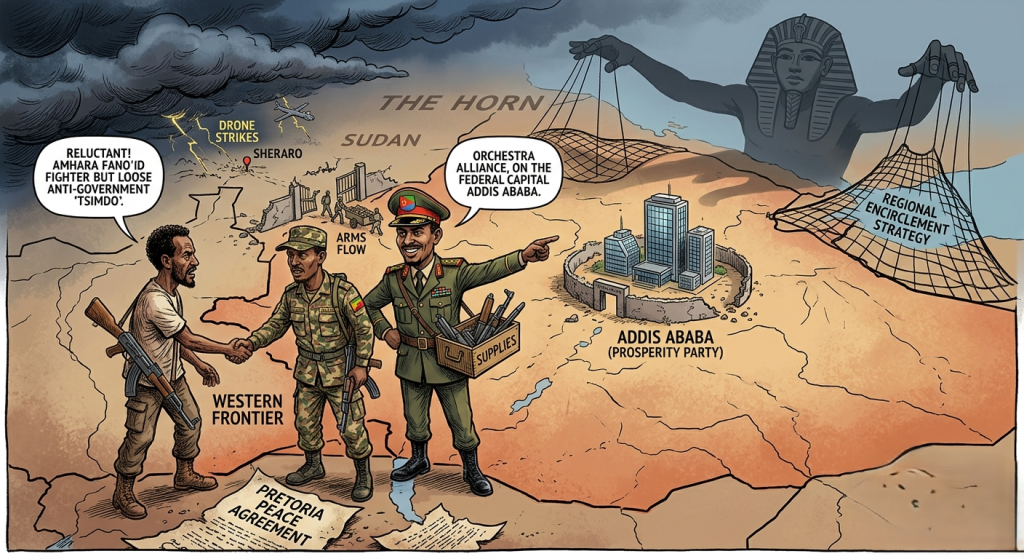
A loose, tactical anti-government alliance colloquially dubbed the “Tsimdo” framework has emerged, linking historic adversaries in a shared bid to counter the federal government in Addis Ababa. This shifting alignment completely redraws the security balance along a corridor already destabilized by internal insurgencies and external proxy interests.
The Western frontier has long been the primary prize and geopolitical flashpoint of Ethiopian domestic politics. During the 2020–2022 civil war, the corridor was a brutal battleground where Eritrean forces and Amhara militias partnered with the federal state to seal off Tigray. Today, that exact geography is facilitating an inverted security matrix.
Sidelined by the Pretoria accord and deeply threatened by Prime Minister Abiy Ahmed’s aggressive rhetoric regarding a sovereign Red Sea maritime port, Asmara has shifted its posture. No longer acting as an occupying force, Eritrea is operating as a strategic counterweight for dissident Tigrayan factions. Clandestine coordination and logistics are transforming the northern border from a containment zone into a backyard for tactical leverage against Addis Ababa.
The most unexpected variable is the loose security coordination between Amhara’s Fano militias and hardline Tigrayan elements. Despite fighting a bitter war over the disputed territories of Western and Southern Tigray, their shared existential opposition to the Prosperity Party has created a pragmatic truce. For Fano, an active or resource-heavy northern frontier thins out the federal military deployment in the Amhara region; for Tigrayan hardliners, the Fano insurgency prevents the federal government from completely enforcing an economic and political siege on Mekelle.
The strategic gravity of this alliance centers heavily on the fractured border triangle where Ethiopia, Eritrea, and Sudan meet.
[ERITREA] (Asmara)
│
▼ (Logistics & Strategic Counterweight)
[TIGRAY] (Mekelle) ◄──► [AMHARA / FANO] (Internal Insurgency)
│
▼ (The Fractured Border Triangle)
[SUDAN / SAF] (Porus Frontier & Arms Corridors)
The recent federal drone strikes hitting military vehicles in Sheraro just kilometers from the Eritrean border signal that Addis Ababa recognizes the immediate conventional threat building along this corridor.
This western pocket is highly porous and directly interfaces with elements of the Sudanese Armed Forces (SAF). With Sudan itself consumed by a brutal civil war, the borderlands have become a marketplace for arms, fuel, and unregulated cross-border movement. If the Tsimdo framework solidifies, this frontier will no longer function as isolated theater boundaries for the Fano insurgency or the post-Pretoria transition. Instead, it becomes a continuous, synchronized conflict zone where weapons and fighters flow freely from the Red Sea coast through Tigray and Amhara, directly linking into the broader Sudanese theater.
This domestic realignment cannot be decoupled from the wider Nile Basin geopolitics. Egypt, which has consistently sought to counter Ethiopia’s unilateral actions regarding the Grand Ethiopian Renaissance Dam (GERD), views the internal fracturing of Ethiopia’s frontier as a profound geopolitical opportunity.
Cairo has already established a robust military and diplomatic foothold in the Horn through its recent defense pact and troop deployments in Somalia. By aligning its interests with Asmara and monitoring the dissident factions along Ethiopia’s northern and western borders, Egypt is effectively assembling a grand containment ring. A distracted, internally exhausted federal government in Addis Ababa cannot project power effectively in the Red Sea arena or command absolute leverage over regional water politics.
The emergence of the Tsimdo framework proves that treating Ethiopia’s security crises as isolated, regionalized domestic disputes, an Amhara problem, an Oromo problem, or a Tigray transition problem is an analytical failure.
The Western frontier is rapidly integrating into a multi-state proxy arena. As diplomatic mechanisms falter and external actors feed the frontlines with resources, the Horn of Africa faces a dangerous threshold: an interconnected regional war where a single major offensive on the border triangle could trigger a synchronized explosion across three nations.