The Red Sea Strategic Assessment Examining The Impact On Sudan Egypt Ethiopia Eritrea And Horn Of Africa Stability
Strategic Assessment
By Abubakar Abdelrhman, Senior Researcher at the Centre for International Relations and Global History – Realist
The report authored by Peter Salisbury, Wolf Pape, and Henry Thomson in “Foreign Affairs” highlights a critical structural shift in the conflict dynamics across East Africa and the Red Sea basin: the transfer of Houthi military expertise in unmanned aerial vehicles (UAVs) and Islamic Revolutionary Guard Corps (IRGC) tactics to the Sudanese theatre. This evolution is not merely an indicator of expanding transregional non-state actor networks; it also exposes a profound strategic deficit in the regional reading of conflict equations in Sudan and the wider region, alongside a willful blindness by certain active powers toward these empirical indicators.
Notably, the report urged the Donald Trump administration to act urgently to prevent the proliferation of cheap drone technology to Sudan. This urgency stems from the Port Sudan authority’s deployment of allied Islamist brigades to Yemen to train on UAV systems under the supervision of IRGC and Houthi elements.
Revisiting the core premise, the Saudi stance has undergone a notable evolution, diverging from the posture assumed at the crisis’s inception in mid-April 2023. At that time, Riyadh alongside Cairo and other regional powers preferred hesitation and a “gray zone” posture. As the conflict persisted, these capitals underwent a comprehensive strategic reassessment.
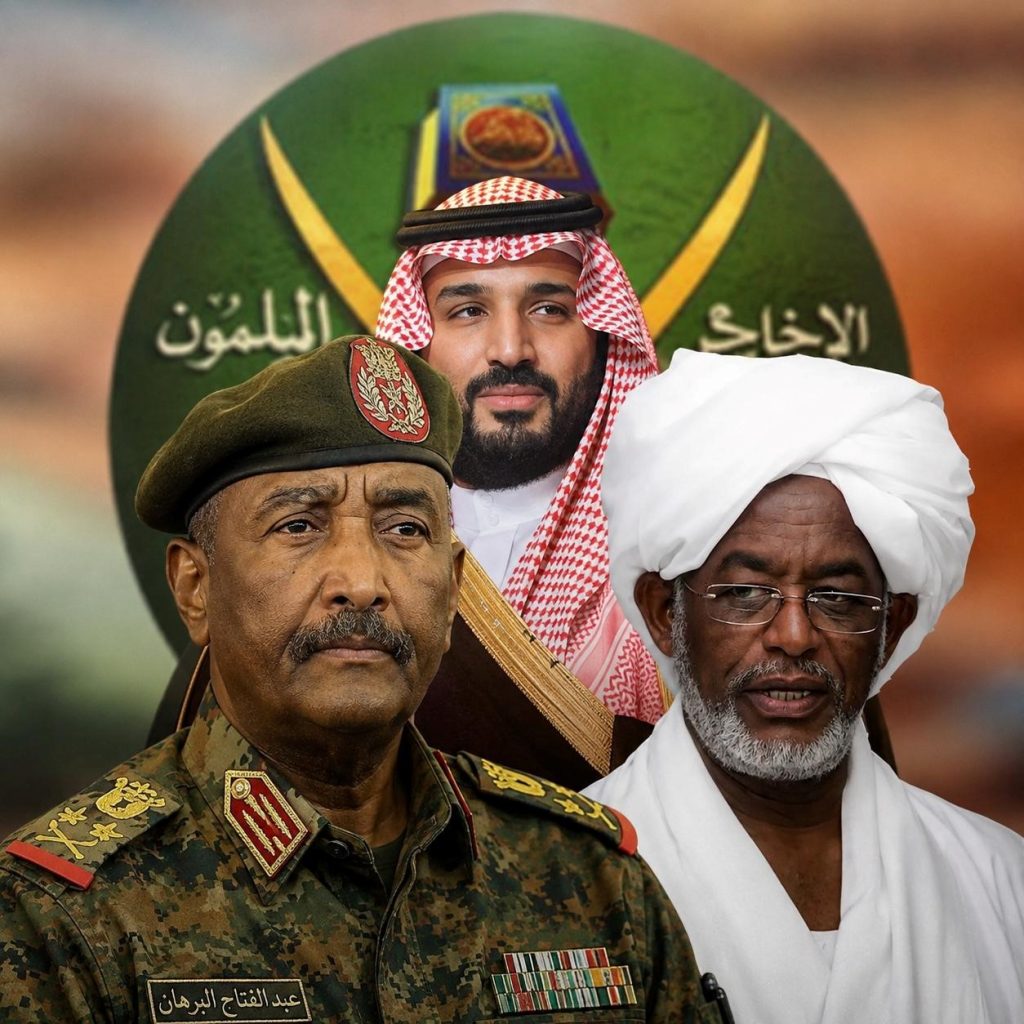
This review generated counterproductive positions that stoked tensions and pushed the landscape toward escalation rather than de-escalation, manifested in generous financial, military, and political backing for the Port Sudan authority. Ironically, while both countries officially combat the Muslim Brotherhood domestically Saudi Arabia banning the group by royal decree in 2014, and Cairo designating it a terrorist organization in December 2013, Cairo and Riyadh downplay the heavy Islamist footprint at the apex of the Sudanese military.
I. Riyadh’s Motivations in Betting on the “Port Sudan Authority”
To grasp the dimensions of current Saudi policy beyond political reductionism, one must dissect the strategic drivers and subjective motives guiding decision-makers in Riyadh toward Port Sudan:
- The Fallacy of “Institutionalism” and the Military as a Stability Guarantor: The Kingdom operates on a traditional security doctrine prioritizing the “preservation of the state apparatus” no matter how compromised or dysfunctional—over alternatives like the ascent of rival armed actors. Riyadh views the military establishment (the SAF) as the sole bulwark against Sudan’s total fragmentation. Two historical parallels challenge this logic:
- Syria: Riyadh supported Ahmed al-Sharaa, despite his ideological background, until he unseated Bashar al-Assad’s regime which had long weaponized state institutions for Ba’athist and sectarian ends. This raises fundamental questions regarding Riyadh’s definition of “institutional legitimacy.”
- Sudan: Historical and empirical evidence proves that the very same ideological faction and military command were the primary architects of Sudan’s historical division and the secession of the South. Relying on the military in its current posture as a unity guarantor ignores recent history, especially given that the state’s decision-making apparatus remains hijacked by Islamist networks.
II. Red Sea Geopolitics and Regional Rivalries
Riyadh acts under legitimate anxieties regarding competing regional and international powers vying for long-term military and economic footholds along the Red Sea coast. However, securing Saudi interests and the Red Sea is far more effectively achieved by fostering a stable, democratic Sudanese state capable of mutually beneficial economic partnerships.
Conversely, backing a compromised authority that fragments the social fabric and prolongs war for the narrow survival of a military leader serves narrow personal interests, stripping away “common interest statecraft” in favor of proxy resource exploitation.
The Reliance on an Authoritarian “Fast-Track” Partner
Saudi Arabia seeks an “official” partner to secure borders and maritime traffic the lifeline of Vision 2030. Tactical calculations lean toward centralized military models capable of unilateral decisions devoid of parliamentary or public oversight. This mirrors past regional dynamics, such as the Gulf’s backing of Abdel Fattah el-Sisi in Egypt post-2013 to neutralize the Muslim Brotherhood. While financial injections (deposits and loans) stabilized Egypt’s economy and absorbed street pressure, they permanently mortgaged Cairo’s independent decision-making.
This vulnerability was exposed when Egypt remained passive amid Iranian attacks on Gulf infrastructure, prompting public backlash in Gulf states regarding Cairo’s compromised sovereignty. In Sudan, the historical precedent of Al-Bashir deploying troops to Yemen and Saudi Arabia for personal financial and political gain epitomizes this fragile transactional model.
III. The Trap of “Containing Islamists” via the Israeli Gateway
Riyadh’s tactical calculus assumes that co-opting and financially supporting the military leadership will provide leverage to eventually “contain” Islamist influence from within, preventing a vacuum. This assumption ignores dynamic political realities and Burhan’s lack of an independent national project.
Once politically and economically empowered by Saudi support, General Al-Burhan will inevitably pivot toward Tel Aviv—a trajectory initiated in 2020. During a secretive 2020 meeting in Entebbe, Uganda, arranged directly with Benjamin Netanyahu, Al-Burhan justified his actions to the Security and Defence Council as serving “supreme national interests.”
IV. Strategic Assets Sought from Israel
The military leadership calculates that Israel offers unmatched assets that Gulf states cannot provide:
- Washington and Brussels Lobbying: Unlocking Western capitals, lifting sanctions, and securing international legitimacy.
- Advanced Security and Cyber Capabilities: Acquiring sophisticated surveillance technology and cyber-weapons to crush domestic rivals and intelligence competitors.
- Monopolizing Normalization: Al-Burhan seeks to hoard the normalization file as a strategic trump card against domestic rivals particularly the “Tasis Coalition” (TASIS)—fearing that rival civilian factions might offer alternative international partnerships that permanently terminate his political survival project.
V. Strategic Contradictions and Divergent Outcomes
These dynamics plunge the Saudi approach into severe practical contradictions:
- Rhetorical vs. Operational Dissonance: While Riyadh sponsors negotiation frameworks (such as the Jeddah tracks) and asserts in Quad declarations that “there is no military solution,” its financial facilitation such as a $1.5 billion arrangement for Pakistani military equipment and logistical support to Port Sudan actively prolongs the war rather than arresting it.
- The Islamist Proxy Paradox: Riyadh bets on decoupling the military from Islamists, whereas field realities (and the Foreign Affairs report) confirm the army command is thoroughly subservient to the National Islamic Front networks. These factions coordinate transregionally with the Iran-Houthi axis, importing UAV technology (Shahed and Mohajer) to sustain power, directly threatening Gulf infrastructure.
Replicating the Yemeni Miscalculation
This mirrors Riyadh’s historical miscalculation in Yemen, where backing pragmatic elements against Ali Abdullah Saleh ultimately empowered the Houthis, who built missile and drone architectures (partially inherited from legacy state structures) that now threaten Saudi territory and international maritime trade.
As a stark indicator of this ideological alignment, during recent US-Israeli escalations with Iran, prominent Islamist figure Dr. Tariq Keijab, former personal physician to Omar al-Bashir publicly urged Iran to “bomb Gulf water desalination plants.” These are the exact radical networks currently embraced by Al-Burhan and tacitly managed by regional actors under a flawed counter-insurgency framework.
Conclusion & Recommendations
Attempting to separate “institutional legitimacy” from the ideological networks operating within the Sudanese military defies political realism. The current SAF command has transformed into an organizational front utilizing war to reclaim power, jeopardizing both Sudanese and regional stability.
- Strategic Reorientation: Providing resources to the military leadership offers zero strategic value to Sudan as a state. True stability requires halting the war and empowering Sudanese civil agency to determine governance, rejecting the military model rejected by the December 2019 revolution.
- The Imperative of Severing Ties: Breaking with Islamist-affiliated militias is not merely a moral obligation dictated by fraternal ties, but an urgent geopolitical necessity for Sudanese, Saudi, and Red Sea security.
- Policy Recommendation: The window remains open for Riyadh to recalibrate its compass, transitioning from “proxy-managed crisis containment” to applying robust pressure targeting the ideological roots of the conflict, thereby halting the entrenchment of Iranian-Houthi influence in eastern Sudan under the guise of “official state legitimacy.”
Note: This Strategic Assessment is written by Abubakar Abdelrhman, Senior Researcher at the Centre for International Relations and Global History – Realist