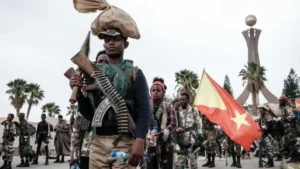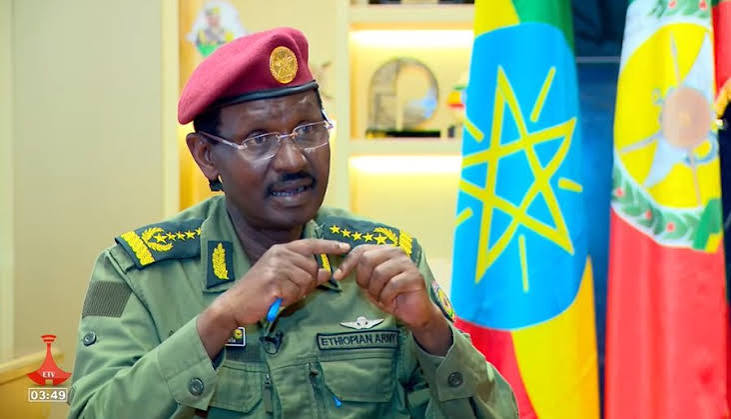
Ethiopia’s Army Chief, Field Marshal Birhanu Jula, has publicly accused Egypt and Sudan of actively funding, equipping, and directing a newly formed coalition of armed and political opposition groups attempting to destabilize Prime Minister Abiy Ahmed’s administration.
Speaking on state media, Birhanu stated that external state actors are intensifying their proxy interventions in Ethiopian domestic affairs. According to the ENDF Chief of Staff, historical and contemporary adversaries of Ethiopia unable to execute a direct military campaign have turned to sponsoring internal insurgent factions to wage a coordinated proxy war across multiple regional fronts.
“These external entities are providing material, financial, and tactical supply pipelines to sustain a new alliance of armed opposition forces,” Birhanu noted, explicitly linking Cairo and Khartoum to the recent structural consolidation of anti-government armed movements operating within Ethiopia’s borders.
The allegations mark a significant diplomatic escalation between Addis Ababa and its neighbor states. Relations between Ethiopia, Egypt, and Sudan have remained severely strained over unresolved geopolitical friction surrounding the Grand Ethiopian Renaissance Dam (GERD), border demarcation disputes along the Al-Fashaga triangle, and the lingering cross-border spillover from Sudan’s internal war.
Diplomatic observers note that these accusations signal growing federal concern over the expanding capacity and coordination of domestic insurgent networks, which the military leadership maintains are surviving primarily through foreign logistical backing.
The convergence of internal Ethiopian armed insurgencies, the ongoing Sudanese civil war, and external state sponsorship marks a dangerous geopolitical shift for the Horn of Africa. What began as localized civil and political strife within Ethiopia has evolved into a multi-theater regional proxy contest that threatens the structural stability of the entire region.
The explicit involvement of external state actors, specifically Egypt and Sudan alongside regional facilitators like Eritrea, signals the formalization of a new proxy front across East Africa. Historically, rivalries in the Horn were managed through localized border skirmishes or political influence. However, the active provision of material, financial, and logistical supply pipelines to an alliance of Ethiopian insurgent factions indicates a deliberate strategy to entrench long-term proxy warfare. By exploiting Ethiopia’s internal security vulnerabilities, external powers aim to constrain Addis Ababa’s regional posture, particularly regarding strategic assets such as the Grand Ethiopian Renaissance Dam (GERD) and sovereign access to maritime trade routes.
The intersection of Ethiopia’s domestic conflict with the broader contest for Red Sea dominance elevates the crisis from a continental concern to a global security bottleneck. The involvement of actors across both shores of the Red Sea including Eritrea, Somalia, Yemen, and Saudi Arabia creates a volatile maritime security nexus. As non-state armed groups align with state sponsors to secure cross-border logistics and weapons flows, vital maritime trade routes through the Bab-el-Mandeb Strait and the southern Red Sea face heightened risks of destabilization, piracy, and unchecked proliferation of advanced weaponry.
At the human level, the systemic commodification of prisoners of war and vulnerable populations illustrates the complete erosion of regional border governance and international humanitarian protections. The establishment of human trafficking pipelines that feed captive Ethiopian personnel and deceived youth into forced combat under the Sudanese Armed Forces (SAF) highlights how state fragility generates illicit economies. This human exploitation not only deepens ethnic and regional grievances within Ethiopia disproportionately impacting communities in Southern Ethiopia but also destabilizes Sudan’s operational theaters, creating an interconnected cycle of violence that undermines regional peacebuilding initiatives for generations.
If left unchecked, this multidimensional conflict risks triggering a total breakdown of state sovereignty across the Horn of Africa. The failure of regional bodies such as the African Union (AU) and the Intergovernmental Authority on Development (IGAD) to enforce border integrity and stop external proxy interventions leaves a dangerous power vacuum. As cross-border alliances solidify between insurgent groups and foreign state actors, the Horn of Africa faces the grim prospect of long-term balkanization, characterized by porous frontiers, humanitarian catastrophe, and persistent regional militarization.