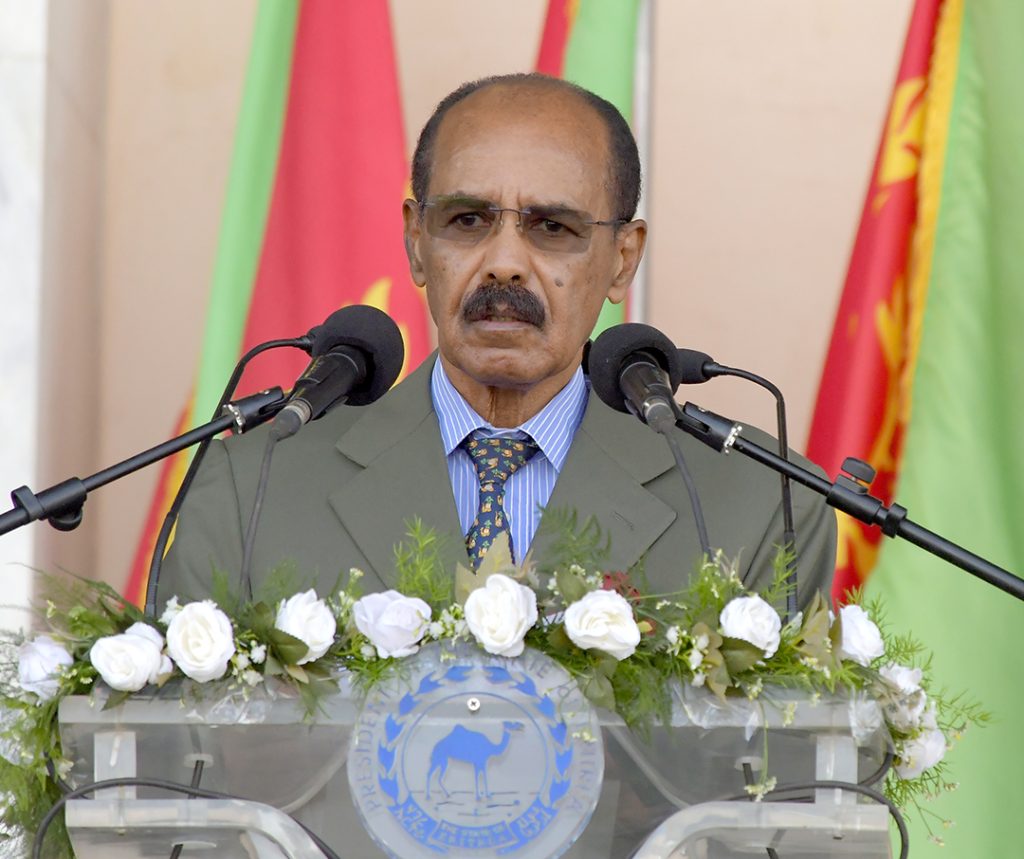
President Isaias Afwerki Address Commemorating Eritreas 35th Independence Anniversary On May 24 2026
In a lengthy, ideologically dense address commemorating Eritrea’s 35th Independence Anniversary on May 24, 2026, President Isaias Afwerki delivered a sweeping critique of both the global financial architecture and the volatile security landscape of the Horn of Africa. Shifting away from standard nationalist triumphalism, the address functioned as an unyielding diagnostic on what Asmara views as a “blocked” regional system and a decaying unipolar world order.
For observers at Ethio Insight, the speech provides critical markers on how Eritrea positions itself against the shifting alliances in Northeast Africa particularly Ethiopia’s hyper-active diplomacy with Western powers and its aggressive pursuit of maritime access.
A significant portion of Isaias’s address was dedicated to a granular critique of U.S. foreign and economic policy under the second Trump administration. Analyzing the “Make America Great Again” (MAGA) doctrine through macroeconomic metrics, Isaias pointed to the skyrocketing U.S. national debt which he noted has ballooned toward $40 trillion and the historic failure of “offshoring” as structural indicators of Western economic decline.
While acknowledging President Donald Trump’s recognition of this decline as “positive,” Isaias expressed deep skepticism toward Washington’s unilateral maneuvers. He explicitly questioned whether aggressive tariff hikes, domestic tax cuts, the monopolization of rare minerals, and high-profile international actions such as the unilateral arrest of Venezuelan President Nicolás Maduro and military friction with Iran could halt the systemic rot.
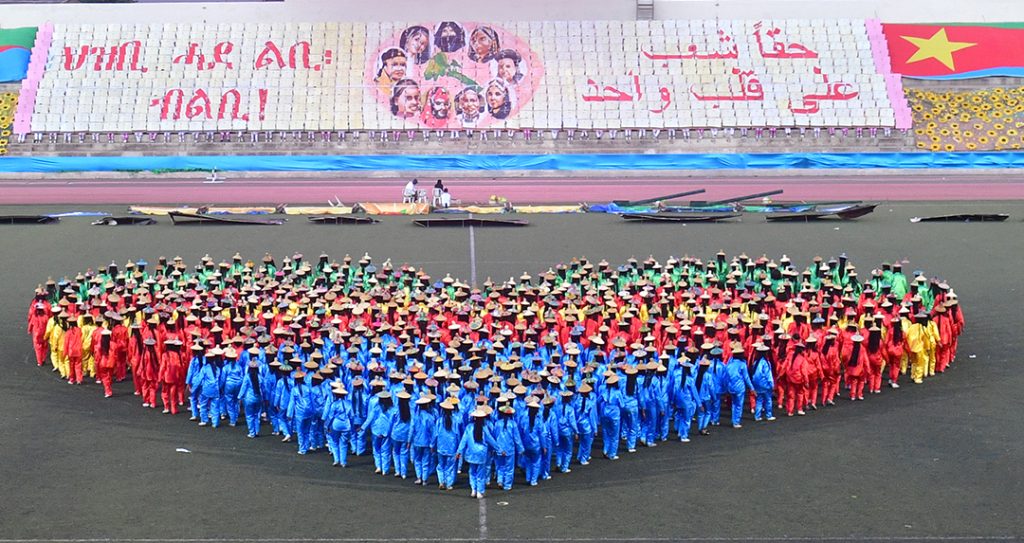
Crucially, Isaias used this global critique to lobby for a structural shift to a “new global order” built on fair trade and the dismantling of “exploitative financial mechanisms rooted in usury, plunder, and deception.” This rhetoric serves a domestic and regional defensive purpose: validating Eritrea’s prolonged isolation from Western multilateral financial institutions while framing the ongoing economic overhauls of its neighbors such as Ethiopia’s IMF-guided liberalization as a submission to “modern forms of colonial domination.”
Turning his gaze to the immediate neighborhood the Nile Basin, the Red Sea, and the Gulf Isaias painted a grim picture of an African Horn that remains fundamentally static, cornered, and increasingly vulnerable to external manipulation following maritime crises near the Strait of Hormuz.
In a stark diagnostic phrasing, President Isaias categorized the current state of affairs in Ethiopia, Somalia, and Sudan as completely “blocked.” According to Asmara’s worldview, the regional mechanism has ground to a halt. By painting the region this way, Isaias is signaling that the current diplomatic configurations, including recent Horn alliances, are failing to offer a path forward.
The most potent segment of the address targeted the very nature of statehood and governance in the region, diagnosing the systemic instability not as mere administrative hiccups, but as existential failures in nation-building. Isaias categorized the regional crisis into four distinct pathologies:
- The Fracture of Citizen Politics: Instead of building citizen-centered nationhood, societies are polarized along vertical ethnic, clan, and religious lines. This continuous fragmentation systematically sabotages the creation of a cohesive national identity in favor of internecine conflict and hatred.
- The Cultivation of Warlordism: In a direct nod to the ongoing internal conflicts in the region, the Eritrean leader warned against the deliberate manufacturing of non-state armed actors and warlords who actively hollow out, replace, and dismantle sovereign state structures and institutional legitimacy.
- Corrosive Institutional Decay: The entrenchment of systemic corruption, embezzlement, and plunder that drastically weakens internal state resilience.
- Subservience to External Interests: The outsourcing of national sovereignty and a growing dependency on foreign patrons and external funding, which compromises the sovereign integrity of regional actors.
Though Isaias avoided naming specific contemporary actors like Prime Minister Abiy Ahmed, the strategic targets of his address were unmistakable to anyone tracking the Horn’s current geopolitical realignment.
Eritrea’s denunciation of “warlordism” and “ethnic polarization” serves as a direct critique of Ethiopia’s complex internal security challenges. More importantly, his demand for the “immediate termination of external interventions and funding” acts as an ideological counter-weight to Ethiopia’s recent diplomatic triumphs, including high-profile visits from IMF Managing Director Kristalina Georgieva and French President Emmanuel Macron.
As Addis Ababa leverages international partnerships to secure direct access to the Red Sea and fortify its macroeconomic reforms, Asmara is attempting to frame these moves as dangerous dependencies that invite foreign intervention into a shared neighborhood. By advocating for a localized, collective security mechanism entirely free of external funding, Isaias is attempting to constrain Ethiopia’s geopolitical maneuvers by painting Western diplomatic and financial alignment as an inherent threat to the stability of the Horn.
This position reaffirms Eritrea’s long-standing geopolitical doctrine: viewing Western and multilateral financial institutions (like the IMF and World Bank) and external security interventions as destabilizing forces rather than solutions.
Domestically, Isaias admitted that Eritrea’s resource mobilization and programs to extricate the country from a subsistence economy might “affect the pace of ongoing development programmes this year.”
Despite potential supply chain delays, he pledged that state-led infrastructure, housing, and social expansions in underserved regions would proceed. He emphasized that road, transportation, electricity, and water projects would start or expand this year alongside quality healthcare and education, anchored firmly by the Eritrean Defense Forces which he termed the “strong shield, kernel, and cornerstone” of the state’s development programs.
Ultimately, the 35th Independence Anniversary address reveals an Eritrea that remains ideologically dug-in, viewing its neighbors’ internal overhauls not as progress, but as structural decay.
As the Horn of Africa faces unprecedented polarization over maritime access and proxy alignments, and as its neighbors engage in high-stakes economic experiments and cross-continental diplomatic balancing acts, Asmara’s prescription remains unchanged: a rigid adherence to sovereign isolation, viewing the external world not as a source of developmental partnership, but as a theater of proxy traps and inevitable collapse.