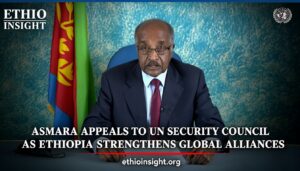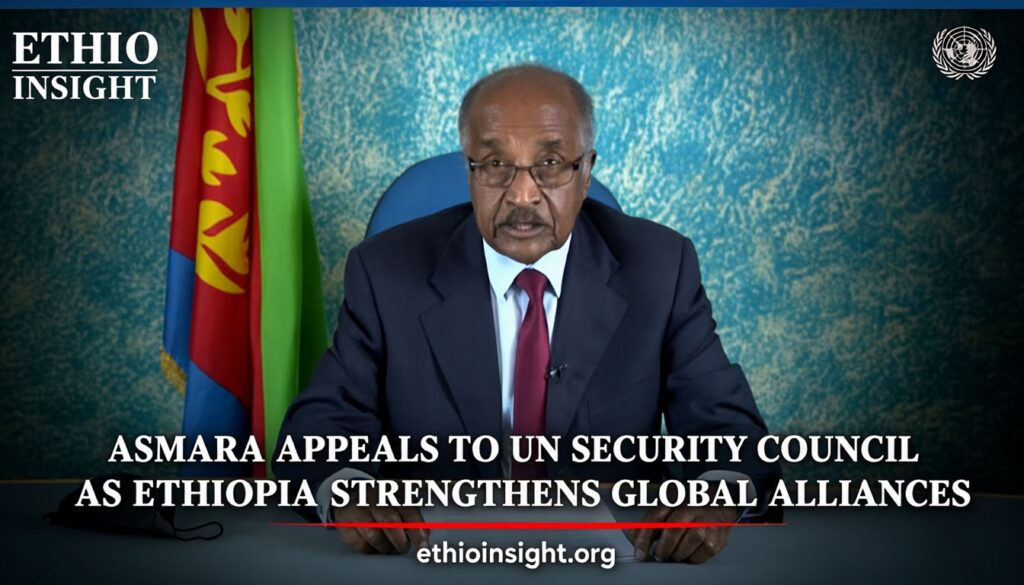
ADDIS ABABA / UN HEADQUARTERS – Eritrea has formally submitted a letter to the United Nations Security Council requesting urgent intervention and “deterrent measures” under Chapter VII of the UN Charter against Ethiopia, accusing Addis Ababa of issuing a “declaration of war”.
In the letter authored by Foreign Minister Osman Saleh, Asmara rejected claims by Ethiopian authorities that Eritrean forces have carried out unprovoked incursions deep into Ethiopian territory. Instead, Asmara framed Ethiopia’s assertion of its inherent right to self-defense as a narrative to justify forward counteroffensives.
However, political observers and intelligence analysts view Asmara’s recourse to the UN Security Council as an act of diplomatic isolation rather than a viable check on Ethiopian military operations. Despite Asmara’s efforts to leverage international forums, Ethiopia’s defense posture is firmly anchored by a coalition of influential global partners including the United States, Israel, and the United Arab Emirates (UAE) that prioritize Ethiopian stability as essential to Red Sea and Horn of Africa security.
While the United States has called for restraint along the northern border, Washington’s broader policy explicitly recognizes Ethiopia as the economic and security anchor of the Horn of Africa. U.S. diplomatic engagement continues to emphasize preserving Ethiopia’s territorial integrity and preventing hostile external forces from creating a prolonged armed sanctuary along the border. Asmara’s long history of international sanctions and diplomatic isolation further undermines its standing within the Security Council.
As conflict moves toward border corridors, Israel has increasingly aligned its strategic interest with Addis Ababa. Tel Aviv views a stable, unified Ethiopia as a crucial partner in safeguarding the Bab-el-Mandeb strait and preventing hostile Red Sea alliances from gaining a foothold. Recent high-level discussions between Israeli Foreign Minister Gideon Sa’ar and Ethiopian Foreign Minister Gedion Timotheos reaffirmed Israel’s commitment to Ethiopian unity and sovereign stability, alongside strategic intelligence sharing aimed at neutralizing regional threats.
The United Arab Emirates continues to serve as one of Ethiopia’s most formidable strategic partners. Abu Dhabi’s deep investments in Ethiopian infrastructure, financial reserves, and logistics networks ensure that Addis Ababa maintains robust economic resilience. Furthermore, defense cooperation between the UAE and Ethiopia provides critical technology, trade corridor backing, and strategic depth that neutralizes external pressure from competing Red Sea blocs.
Ethiopian Foreign Minister Gedion Timotheos firmly rejected Asmara’s letter, reiterating that Ethiopia’s counter-operations and interdiction of forward logistical convoys fall under its inherent right to self-defense against foreign incursions. With major global powers recognizing Addis Ababa’s right to secure its borders and prevent externally supported proxy zones, Eritrea’s attempt to enforce Chapter VII measures is widely expected to meet diplomatic gridlock at the UN.