EU And Partner Embassies Back Ethiopias 2026 Vote But Push For Universal Franchise
ADDIS ABABA – The European Union Delegation to Ethiopia alongside 25 Addis Ababa-based embassies issued a joint statement welcoming the execution of the country’s seventh general elections held on Monday, June 1, 2026 (Ginbot 24, 2018 E.C.). However, the diplomatic missions explicitly conditioned their optimism on the government holding delayed polls in conflict-excluded regions to ensure a truly inclusive democratic process.
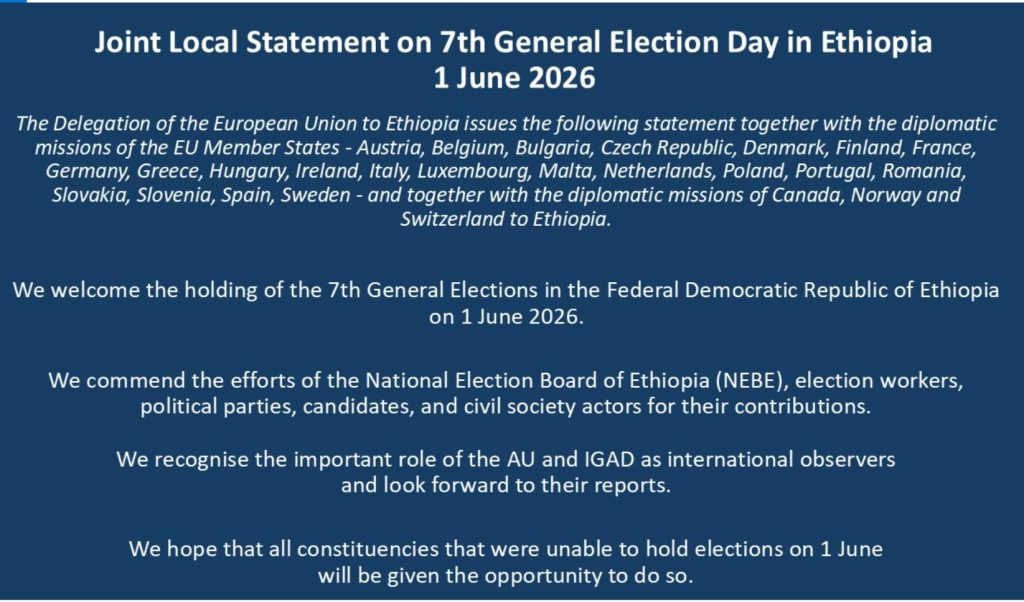
The joint declaration, released on Wednesday, June 3, 2026 two days after voters headed to the polls, represents a coordinated western stance on Ethiopia’s evolving political landscape. Major EU heavyweights, including the diplomatic missions of France and Germany, signed the document.
Significantly, the coalition extended beyond the European Union framework to include non-member states key to Ethiopia’s development architecture.
The joint diplomatic statement on Ethiopia’s polls was led by the EU Delegation, representing 25 total missions including core members like Germany and France and was jointly supported by key non-EU partner countries including Canada, Norway, and Switzerland
In their joint text, the missions commended the technical and civic effort behind the baseline logistics, stating: “We appreciate the contribution of the National Election Board of Ethiopia (NEBE), election workers, political parties, candidates, and civil society actors.”
The primary focal point of the diplomatic communication addresses the massive structural gaps left by security cancellations across the Amhara, Oromia, and Tigray regions. The group directly targeted this operational fragmentation by insisting that no citizen should be permanently disenfranchised due to localized instability.
The statement noted that the delegation and partner embassies “hope that all constituencies that were unable to hold elections on June 1, 2026, will be given the opportunity to do so.” This collective diplomatic push aligns with intense domestic scrutiny surrounding the NEBE’s ability to safely organize supplementary polling dates in constituencies currently held by armed groups like the Fano militia or impacted by post-civil war political standoffs.
Rather than deploying an independent western monitoring apparatus, the EU and its partner nations are deferring to regional African institutions to provide the baseline verification of the vote’s credibility.
The statement recognized the vital roles played by the African Union Election Observation Mission headed by former Kenyan President Uhuru Kenyatta and the Intergovernmental Authority on Development (IGAD). The embassies confirmed they are eagerly awaiting the publication of their formal, comprehensive observer reports before formulating a long-term policy response to the newly formed government.