A Visual Critique Of US Health Diplomacy
Nairobi – Human Rights Watch has issued a critical assessment regarding the true cost of American humanitarian assistance across Sub-Saharan Africa. In a comprehensive legal and human rights evaluation published on June 8, 2026, the prominent international watchdog raised serious concerns over a series of new, secretive bilateral health agreements quietly brokered between the United States government and several African nations, including major regional actors in East Africa and the Horn such as Ethiopia, Kenya, Uganda, and Rwanda.
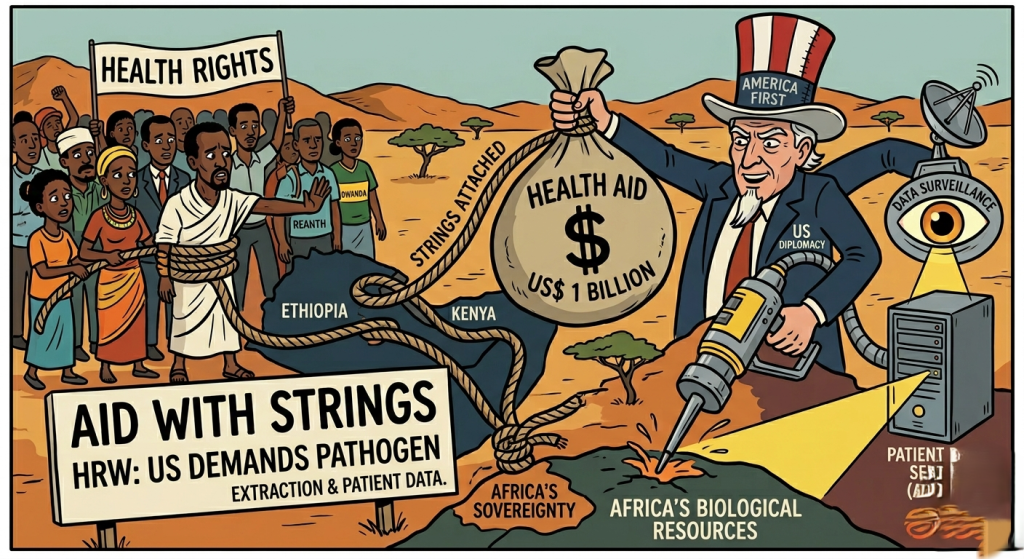
According to the watchdog, these binding compacts introduce highly restrictive, unprecedented conditions. The rules could severely undermine patient data confidentiality, limit local administrative autonomy over national healthcare choices, and extract sovereign biological resources without giving fair compensation to the host nations.
The roots of the current friction trace back to early 2025, when the United States government completely dismantled the US Agency for International Development (USAID). This structural elimination immediately caused a major public health crisis across the developing world.
The shutdown abruptly cut vital healthcare supply chains and terminated ongoing humanitarian initiatives globally. This included stripping more than 800 million US dollars in baseline operational health funds from seven key partner countries: Ethiopia, Kenya, Uganda, Rwanda, Mozambique, Nigeria, and Liberia.
In the wake of this sudden funding void, Washington pivoted toward a highly transactional diplomacy model under its newly enacted “America First” Global Health Strategy. Bilateral negotiations for a fresh wave of five-year health pacts (spanning 2026–2030) were rapidly executed in late 2025 to replace the lost funding.
However, these agreements remained shrouded in extreme secrecy. Under the legal mandates of the Case-Zablocki Act, the US State Department briefly uploaded the concluded texts for Ethiopia, Kenya, Uganda, Nigeria, and Mozambique to its online Freedom of Information Act (FOIA) library on March 13, 2026. Within days, the files were completely scrubbed from government portals.
This sudden removal followed a separate media exposé revealing that US diplomats had explicitly conditioned a 1 billion US dollar health package for Zambia on securing direct extraction rights to vital local minerals. The parallel agreements involving Rwanda and Liberia were never officially published by the State Department and only reached the public through subsequent document leaks.
For regional analysts in the Horn of Africa and the wider East African Community (EAC), the most alarming provisions in these pacts center on the mandatory sharing of biological resources. The Memorandums of Understanding (MoUs) signed by Ethiopia, Kenya, Uganda, Rwanda, and Mozambique explicitly include clauses that compel recipient nations to supply the United States with physical biological specimens, active pathogen strains, gene sequencing details, and real-time epidemiological tracking data connected to emerging infectious disease threats.
Human Rights Watch warns that these provisions represent a deeply uneven extraction system. The text reveals that the United States receives access to raw viral and bacterial assets from East Africa, but the agreements provide no reciprocal guarantees ensuring that these host nations will receive affordable or equitable access to any commercial vaccines, diagnostics, or therapies subsequently engineered from their own genetic material by Western pharmaceutical corporations.
The bilateral pacts also mandate that African signatories allow American authorities sweeping oversight and direct access to internal domestic health tracking networks. This structural surveillance raises serious compliance issues for patient confidentiality:
- Absence of Safeguards: While Ethiopia’s specific text contains clauses asserting that personal records will be handled according to domestic legal frameworks, the broader agreements fail to establish clear limits, independent oversight bodies, or uniform digital safeguards.
- Corporate Sharing: The current terms do not include any explicit bans preventing private health metrics from being shared directly with US pharmaceutical firms without obtaining the formal consent of the patients.
- The Resistance: These broad intrusions into state sovereignty have already provoked a sharp diplomatic backlash. Ghana officially withdrew from negotiations in April 2026, citing unacceptable demands regarding data exploitation. Similarly, Zambia and Zimbabwe previously rejected the proposed assistance framework due to concerns over data privacy and national sovereignty.
Beyond data tracking, the agreements grant American officials the authority to conduct unannounced, independent inspections of local clinics and hospitals. These spot checks are designed to verify strict compliance with the Helms Amendment, a long-standing US legislative restriction that bars foreign aid from being used for abortion services or reproductive options counseling.
Human Rights Watch argues that forcing sovereign health systems to accommodate these strict external checks creates an atmosphere of institutional fear. Healthcare systems are under immense pressure to avoid any funding cuts, which could push local administrators to adopt overly restrictive interpretations of reproductive healthcare policies. This could ultimately limit the availability of legal, lifesaving medical treatments.
Furthermore, the pacts focus heavily on direct government-to-government funding structures while sidelining community-based organizations. Rights groups warn that this shift could weaken grassroots networks that are critical for delivering localized care, particularly in vulnerable areas focused on HIV/AIDS prevention, treatment, and outreach.
The sudden public alarm raised by Human Rights Watch directly validates earlier domestic warnings. In January 2026, the independent regional media outlet Addis Standard published an in-depth academic analysis that scrutinized the initial signing of Ethiopia’s five-year health cooperation MoU.
That early assessment warned that while the partnership was publicly framed as a collaborative tool to strengthen epidemic preparedness and expand capacity building, it carried significant, long-term trade-offs.
The analysis cautioned that deep financial dependency on external assistance could allow foreign priorities to subtly reshape national health policies. It also noted that these structural commitments could erode the decision-making autonomy of local public health institutions.
As global health experts call for a return to transparent, rights-respecting humanitarian aid, the current consensus from civil society remains clear: without active community oversight, multilateral coordination, and strong protections for sovereign resources, these modern aid frameworks risk turning vital humanitarian partnerships into transactional extraction tools.