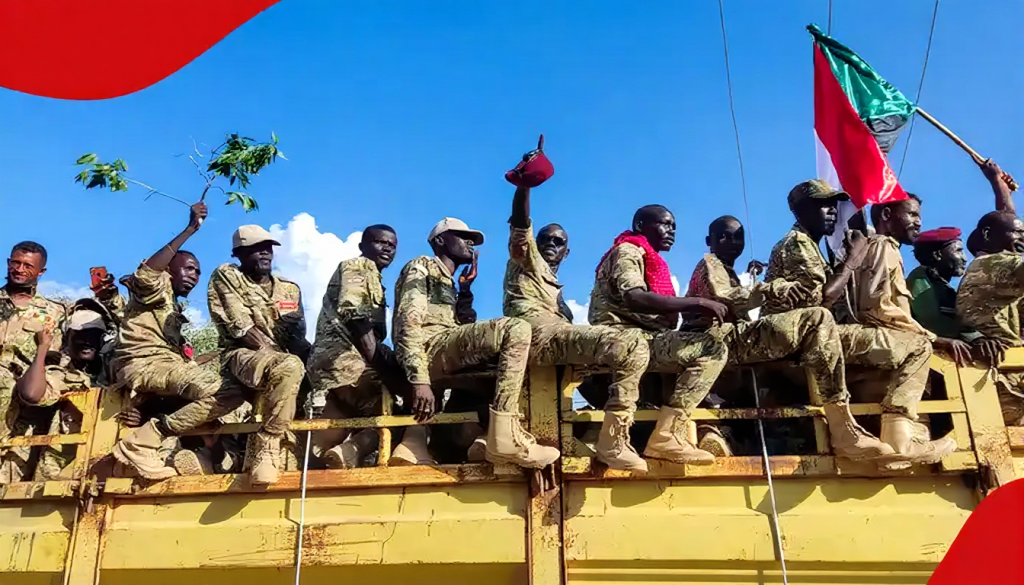
A Truck Carrying Men Affiliated With Sudans Army Drives On A Street In The Eastern City Of Gedaref. Source Getty Images
Regional Networks, Local Wars: How Cross-Border Recruitment is Dragging the Horn into Sudan’s Conflict
ADDIS ABABA – Recent media reports monitoring geopolitical developments across the Horn of Africa have exposed a growing, highly complex web of regional military involvement, cross-border human trafficking, and foreign proxy recruitment driving the ongoing war in Sudan.
According to consolidated accounts from various regional outlets, military training centers in Somalia, youth recruitment networks operating out of Ethiopia’s Tigray region, financial backing linked to Saudi Arabia, and a resurgence of Muslim Brotherhood-affiliated political factions are intersecting to establish new cross-border supply lines of fighters for the Sudanese Armed Forces (SAF).
Together, these developments signal a dramatic shift: the confrontation in Sudan is no longer confined to internal military clashes, but is increasingly relying on a commercialized, transnational infrastructure that threatens the wider stability of the Horn of Africa.
Developments monitored by Voice of Horn, an outlet tracking security dynamics in the Horn of Africa on X indicate that Saudi Arabia is actively overseeing a comprehensive military training program located in Somalia’s Galguduud region.
- Scale and Deployment: The program reportedly involves over 5,000 Somali recruits currently undergoing preparation to be deployed directly into Sudan to fight alongside the Sudanese Armed Forces (SAF).
- Foreign Military Personnel: The physical and tactical training within these camps is not being managed solely by local forces; rather, it is being conducted by foreign military contractors hailing from Romania, Ukraine, South Africa, and Colombia.
- Funding and Logistics: Reporting from BML Daily corroborates these claims, confirming that these training facilities in Somalia receive direct funding from Saudi Arabia. The outlet notes that the eventual deployment of these trained recruits to active Sudanese battlefronts raises severe questions regarding the intent of regional actors and which political factions stand to gain from injecting new waves of fighters into the conflict.
While training operations expand in Somalia, a parallel recruitment pipeline is actively operating within Ethiopia’s northern borders.
According to a report by Addis Standard, Ethiopian Prime Minister Abiy Ahmed publicly raised alarms over covert networks operating in the Tigray region. Prime Minister Abiy stated that these illicit groups are actively recruiting young people including minors and smuggling them across the border to fight in a Sudanese conflict that has no direct connection to them.
- Exploitation of Conditions: The Prime Minister emphasized that these recruitment networks are systematically taking advantage of Tigray’s fragile post-war economic state and dire humanitarian conditions to entice vulnerable youth.
- A Growing Transnational Threat: Abiy warned that this practice represents a major security and humanitarian challenge that extends far beyond Ethiopia’s borders, risking the re-militarization of vulnerable populations and creating long-term instability along the shared frontier.
- The Re-emergence of the Muslim Brotherhood and Islamist Factions
Beyond the physical recruitment of troops, media analysis points to a significant ideological and structural shift within Sudan’s military leadership.
An in-depth analysis published by The Sudan Times argues that the prolonged duration of the war has created a power vacuum, enabling political and military networks affiliated with the Muslim Brotherhood to re-establish their footing within Sudan’s state and military establishment.
- The al-Baraa bin Malik Brigade: The Sudan Times explicitly highlighted the rise of armed ideological formations, most notably the al-Baraa bin Malik Brigade. These groups are utilizing the active conflict to regain the political clout, state influence, and military authority they had previously lost.
- Reshaping Power Dynamics: The publication asserts that bringing in fighters recruited from outside Sudan’s borders is part of a broader, calculated effort to reinforce the SAF’s manpower. In doing so, these Islamist-aligned factions aim to reshape the internal balance of power as the war expands, consolidating their control over the country’s future.
Collectively, these reports depict a conflict whose scope has expanded well past Sudan’s administrative borders. The intersection of foreign military capital, regional geopolitical maneuvers, and local economic hardship has turned the Horn of Africa into a synchronized supply route for war.
For Ethiopia, the fallout is multi-layered:
- Border Insecurity: The active smuggling of Tigrayan youth across the border creates an immediate security hazard, threatening to bring trained, militarized actors back into Ethiopia’s fragile northern areas.
- Encirclement and Proxy Pressure: The presence of foreign contractors and Saudi-backed hubs in Somalia, paired with a surging Islamist presence in Sudan, complicates Ethiopia’s regional posture, placing additional strain on its diplomatic and security bandwidth.
- Humanitarian Cost: The systematic exploitation of economically desperate youth and minors across international lines significantly worsens the human trafficking crisis across the region.
While no official public statements or formal denials have been issued by the governments or entities named in these reports, the documented activities portray an evolving landscape where geopolitical ambitions, mercenary arrangements, and local vulnerabilities collide, driving up the humanitarian toll and destabilizing the Horn of Africa as a whole.