Ethiopia Revokes Reuters Accreditation Following Investigative Report On Sudan War Involvement
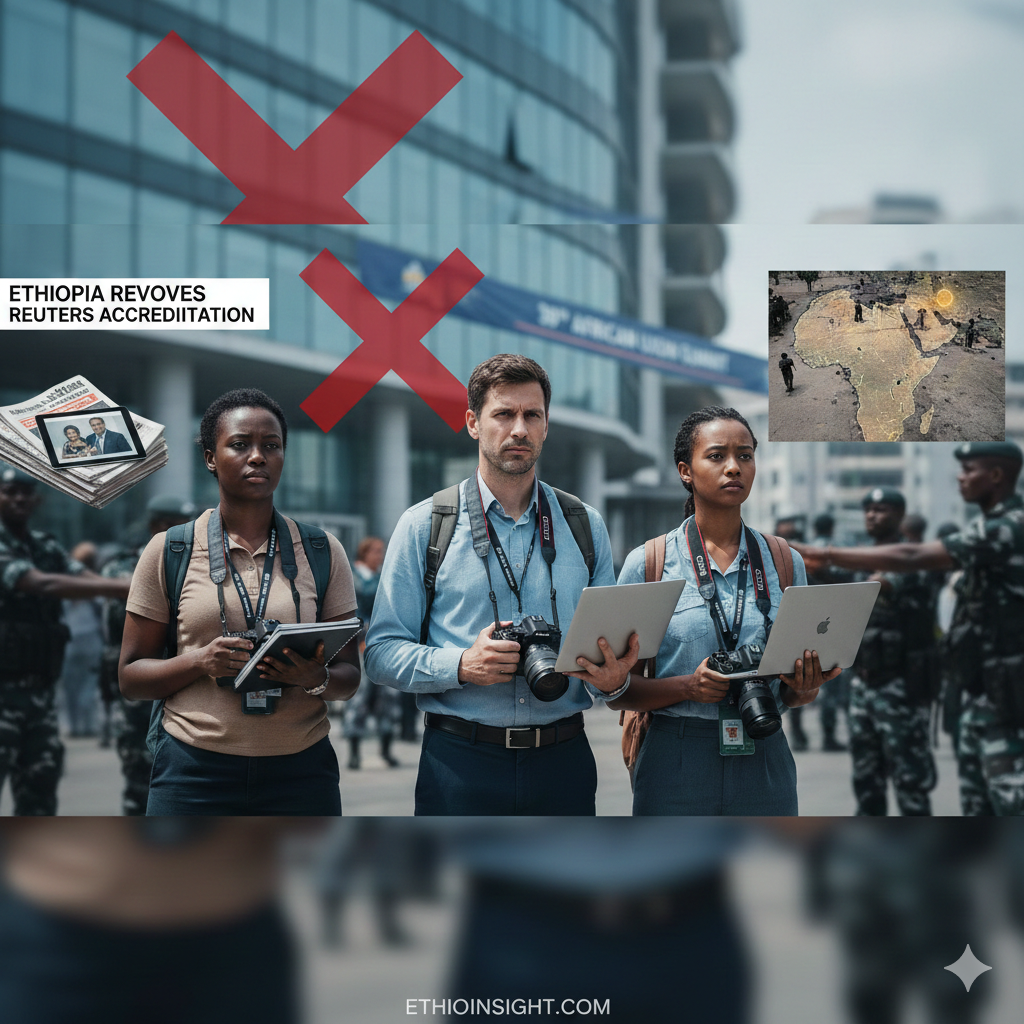
ADDIS ABABA – The Ethiopian Media Authority (EMA) has declined to renew the accreditation of three Addis Ababa-based Reuters journalists, a move that follows the news agency’s recent investigation into Ethiopia’s alleged involvement in the Sudanese civil war.
The decision, which became public on February 14, 2026, also saw Reuters barred from covering the 39th African Union (AU) Summit held in the capital over the past weekend.
The crackdown follows a February 10 investigative report by Reuters alleging that Ethiopia is hosting a secret military camp in the Benishangul-Gumuz region. The report claimed:
- The camp is used to train thousands of fighters for Sudan’s paramilitary Rapid Support Forces (RSF).
- The facility is reportedly financed and supported by the United Arab Emirates (UAE).
- Satellite imagery and internal security memos were cited as evidence of the camp’s existence near the town of Menge.
While the EMA has not issued an official public statement, Reuters confirmed the regulator “informally indicated” the investigative piece was the catalyst for the revocation. The UAE has dismissed the allegations as “unfounded,” while the Ethiopian government has yet to offer a formal response to the report’s findings.
The Committee to Protect Journalists (CPJ) issued a statement from Nairobi on Monday, calling for the immediate restoration of the journalists’ credentials.
“The revocation of Reuters’ credentials is the latest in a troubling pattern of repressive regulatory action against international and independent press in Ethiopia,” said Muthoki Mumo, CPJ Africa Program Coordinator. “Authorities should stop treating critical journalism as a threat.”
This incident is part of a broader trend of tightening media space in Ethiopia:
- October 2025: Suspension of nine Deutsche Welle (DW) correspondents; two remain banned from covering the Tigray and Amhara regions.
- January 2026: Revocation of the operating license for Wazema Radio, with authorities citing reporting that contradicted “national interest.”
Despite the restrictions, Reuters stated it is reviewing the EMA’s decision and remains committed to reporting on Ethiopia in an “independent, impartial, and reliable way,” in accordance with the Thomson Reuters Trust Principles.