Minutes Of A Stormy Meeting Between Abiy Ahmed And The Saudi Foreign Minister
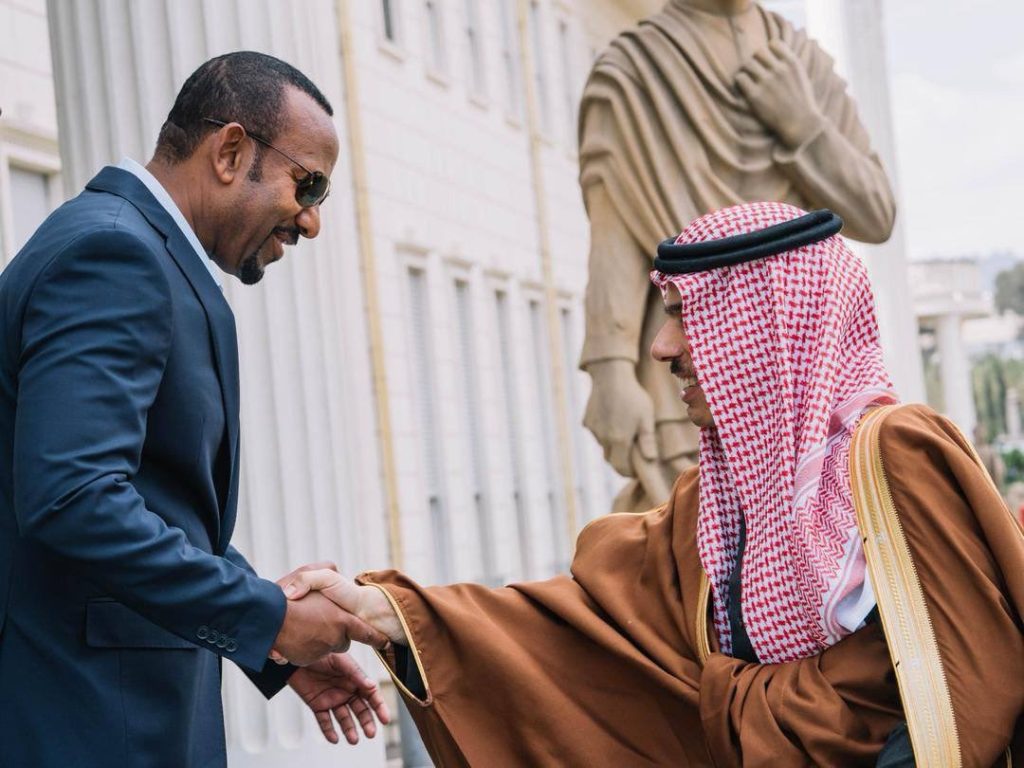
The website Libangate has obtained the minutes of a tense and stormy meeting between Ethiopian Prime Minister Abiy Ahmed and Saudi Foreign Minister Prince فيصل بن فرحان (Faisal bin Farhan). The discussion addressed sensitive regional files linked to the intersections of Ethiopian–Emirati relations and their repercussions on the Sudanese landscape and regional security.
According to the minutes, the episode began when Saudi officials requested a meeting with Prime Minister Abiy Ahmed in the Kingdom to discuss a matter of utmost importance. In response, Addis Ababa swiftly dispatched its Foreign Minister, Gedion Timotheos, who arrived in Riyadh on February 2, 2026.
During the meeting, the Saudi foreign minister raised the issue of the strategic relationship between Ethiopia and the United Arab Emirates, arguing that Abu Dhabi was playing with the security of the Kingdom and the region, particularly in Sudan. He called on Ethiopia to scale back its strategic ties with the UAE.
The Ethiopian response, according to the minutes, was clear and direct. Timotheos stressed that these were Gulf matters in which Ethiopia had no role, and that they could be resolved among “brothers.” He added that Ethiopia wished well for both sides. He underscored that relations with the UAE were built on solid foundations, describing the Emirates as a reliable partner whose support could not be denied, making it difficult to introduce any negative change in the relationship. He further expressed Ethiopia’s aspiration to build a similar relationship with Saudi Arabia and promised to convey the full picture to Abiy Ahmed.
After this visit, no additional response came from Prime Minister Abiy Ahmed. When the Saudi side followed up for clarification, they were told that what the foreign minister had stated represented Ethiopia’s official position, with nothing further to add.
Economic Measures and Escalation
The minutes indicate that this was followed by economic pressure measures from Riyadh against Addis Ababa, particularly concerning cargo transport operations. The Ethiopian side maintained silence and sent no messages or inquiries.
Subsequently, Riyadh requested a direct meeting with Abiy Ahmed to gauge his position following the escalation. The Ethiopian prime minister received the Saudi minister in Addis Ababa on February 10, 2026, where Prince Faisal again raised the issue of what he described as the “Emirati threat” to regional and Saudi national security.
Confrontation Over Sudan
Abiy Ahmed reportedly asked: “What security are you referring to? And what does the relationship between the UAE and Ethiopia have to do with your national security?”
The Saudi minister replied that he was referring to Sudan and the UAE’s support for Rapid Support Forces commander Mohamed Hamdan Dagalo (Hemedti).
According to the minutes, Abiy Ahmed’s response was sharp: “Allow me, Your Excellency, it appears you are neither fully informed nor fully aware of the situation in Sudan. Let me be frank: it is we who support Hemedti in confronting the extremist Islamist gangs led by al-Burhan. You should know that the Kingdom has no control over Addis Ababa’s decisions. This matter is a purely Ethiopian national security issue, and you have no standing in it. You are thousands of kilometers away.”
He added that it was “strange” that Saudi Arabia supported a man who had gathered “all the terrorists of Islamist extremism” to threaten Ethiopia’s security and that of the region, without fully understanding the consequences, and then came to complain about Ethiopia and the UAE.
The Relationship with the UAE
The Saudi minister told Abiy Ahmed: “You do not understand the danger posed by the UAE and the schemes of its ruler.”
Abiy responded: “Are you speaking about the same UAE I know, and Sheikh محمد بن زايد (Mohammed bin Zayed)?”
The minister replied yes, adding that Abiy did not know him well.
Abiy answered: “On the contrary, I am the one who knows him—not you. I tested him in the most difficult circumstances, and he was supportive and honorable, knowing only loyalty. I will repay him only with loyalty. It is enough that he did not impose an embarrassing condition on Ethiopia when he was capable of imposing any condition he wished. His only stipulation was that nothing should occur that would affect Egyptian security and relations with the Arab world.”
He expressed astonishment at the Saudi position, saying it bore no resemblance to what he had personally experienced in his dealings with the UAE and its ruler.
A Message to Crown Prince Mohammed bin Salman
In a firm tone, Abiy Ahmed reportedly told the Saudi minister: “Inform Prince محمد بن سلمان (Mohammed bin Salman) that I will not allow terrorism to rule Sudan and threaten Ethiopia’s security, whatever the cost. What you are doing threatens our national security and will reverberate across the region.”
Addressing the minister directly, he added that Saudi Arabia had “lost its compass,” shifting from supporting enlightenment and reform to embracing an extremist group without understanding the disasters this could bring in the future. He advised them to focus on development and the economy and to stay away from such files, stressing that Ethiopians had lived through wars and paid the price of extremist violence and that war was not a game.
When the Saudi minister pointed out that his country was in an alliance with Egypt and that this formed part of its security—an implicit warning—Abiy replied: “Tell the Prince that Ethiopia is concerned with Egypt’s security because it is part of its own. During the water crisis, I promised Sheikh Mohammed bin Zayed that I would not cut a single drop of water from Egypt or Sudan. In fact, annual volumes have doubled, and I remain committed to that promise. A man’s word to another man is a debt that only men understand.”
The Saudi minister concluded by saying: “The message has been delivered,” according to Libangate.


11 thoughts on “Libangate Reveals: Minutes of a Stormy Meeting Between Abiy Ahmed and the Saudi Foreign Minister”
Comments are closed.